

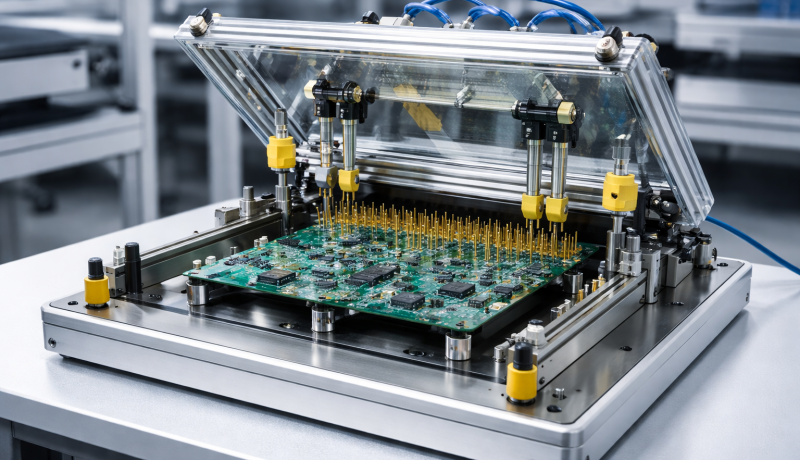

Printed Circuit Board Assemblies (PCBAs) testing failures on the factory floor are not dramatic. They are disguised as inconsistencies that scramble yields and cause you to waste time on non-problems. Most of the time, the difference between testing failure and clarity is not a better engineer but a reliable testing fixture.
Table Of Content
The true measure of a PCB test fixture manufacturer is not how aggressive their fixtures are, but how precise the testing is to generate repeatable results. That way, when a PCB fails, the truth is unmistakable. Here are the common PCBA testing failures you will see on the factory floor.
Intermittent Opens
Poor probe contact can cause a unit to fail a test yet pass a retest. It’s also evident when an operator presses the PCB harder or reseats the unit to generate different results, or when failure is clustered around a specific test point.
To prevent intermittent opens, ensure:
- Correct alignments to pins, holes, rails, and rotation keys
- Controlled clamping for even contact
- Proper probe selection to correct contact resistance
- Slight lateral wipe to break surface films
- Regular maintenance so worn-out parts don’t degrade the yield
False Shorts
Solder balls, flux, ionic residue, moisture film, or dendritic growth can form unintended conductive paths that read like shorts. If these failures often occur in humid conditions and disappear after cleaning, then you are dealing with a contamination issue.
PCB test solutions reduce misinterpretations by:
- Guarding and shielding to reduce leakage paths
- Establishing grounded referencing
- Dedicated isolation tests
- Custom covers to reduce condensation
- Repeatable and localized feedback to pinpoint problems
Wrong Component Value
Incorrect component placement during assembly can introduce deviations that appear as performance drifts. Programmed coordinates, feeder assignments, and visual alignments validate mechanical assembly but cannot detect component mismatch.
Manufacturers trace errors to the specific component by:
- Running an ICT fixture test to measure passive values at nodes
- Kelvin (4-wire) probing to eliminate lead and contact resistance
- Test sequencing focusing on sections with wrong values
- Boundary scanning to validate connectivity and placement
Missing Components
Printed circuit boards are assembled according to a specific design to achieve the desired outcome. A missing component results in a complete lack of function and creates an electrical condition the circuit was not designed to tolerate.
PCB test fixture detects missing components by
- Node-to-node continuity mapping to expose floating or unterminated nets
- Capacitance or resistance checks to confirm missing caps
- Mechanical stabilization to prevent accidental contact
- In-circuit testing to verify and diagnose functional symptoms
Solder Cracks
A microscopic fracture in a solder joint turns into a resistive connection. Solder cracks develop due to mechanical, thermal, and process-related stresses. PCB test solutions detect solder cracks by monitoring load, vibration, and temperature changes.
Proper testing exposes solder cracks through:
- Powered functional loading to test stress power and signal paths
- Dynamic testing to detect voltage droop or instability
- Thermal stress testing for repeatable and predictable thermal and operator variation
- Low resistance measurements to detect meaningful resistance changes
The Real Measure of Quality
PCBA test failures are apparent. PCB test fixtures provide controlled contact, loading, sequencing, and operator interaction to isolate known defect types and separate real defects from inconsistent testing noise.
This data enables faster root cause analysis, feedback, and process improvement. PCB test fixture manufacturers not only validate PCB assembly but also the design intent by facilitating fixturing, stable references, and defined sequencing.
Conclusion
PCBA testing failures often manifest as minor inconsistencies, but they can significantly affect production quality, yield, and efficiency. Identifying issues such as intermittent opens, false shorts, incorrect component values, missing components, and solder cracks requires accurate and repeatable testing processes. Reliable PCB test fixtures play a critical role in ensuring consistent probe contact, proper alignment, and stable electrical measurements. By enabling precise diagnostics and reducing testing variability, well-designed fixtures help manufacturers quickly identify real defects, improve root cause analysis, and maintain consistent product performance. Ultimately, accurate testing supports higher quality standards, minimizes production delays, and ensures dependable PCB assembly outcomes.





No Comment! Be the first one.