

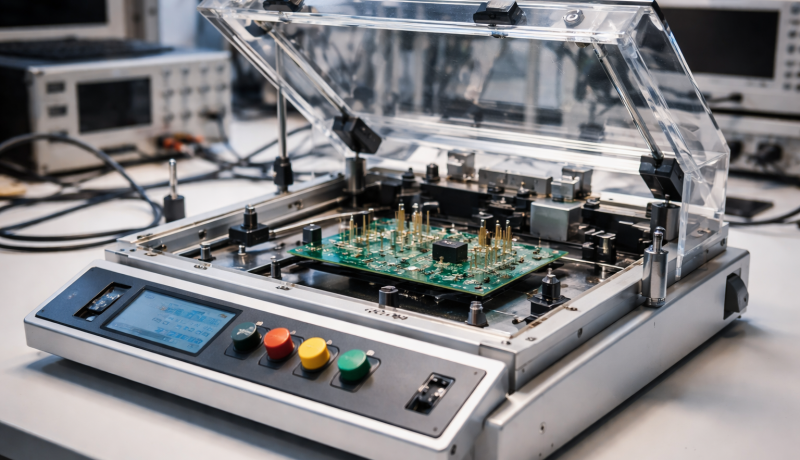

Electronic manufacturers always want to ensure optimal performance, reliability, and functionality of products. That’s why testing the printed circuit board is a vital step in the electronic manufacturing sector. But have your products ever failed even after conducting in-circuit testing? ICT involves measuring and evaluating components on your PCB. It helps you identify defective components that need replacement. However, not every issue appears at the component level. This is where you have to rely on functional test fixtures, which bridge the gap by uncovering hidden problems in the real operating conditions.
Table Of Content
- What is a Functional Test?
- What is In-Circuit Testing?
- Issues That Are Not Detectable With Ict
- Software- and firmware-related complications
- Synchronisation and timing errors
- Failure in communication
- System integration defects
- Types Of Functional Testing Methods For Your Electronic Items
- Hot mock-up test
- Simulation-based test
- Automated functional test
- Various Applications Of Fct Fixtures
- Conclusion
What is a Functional Test?
FCT is a quality-control method used in electronics manufacturing to verify PCB assembly. Other testing processes analyze only solder joints or individual components, whereas functional tests assess the board as a complete, functional system.
To conduct the functional test, you need to power up your PCBA to deal with different input signals. The test fixture determines the output to ensure it matches expected values. The functional test identifies defects, such as component interactions, timing problems, and firmware bugs.
What is In-Circuit Testing?
ICT is intended to measure and test the components on the board. This testing process allows you to detect defective parts of your product. You will be able to find the wrong components and solder shorts. In-circuit testing fixtures have the potential to conduct multiple tests without providing power to the device.
Issues That Are Not Detectable With Ict
Check the list of problems that you cannot detect with in-circuit testing.
Software- and firmware-related complications
ICT fails to confirm the correct booting of firmware and execution of logic. On the contrary, functional testing allows you to identify booting issues, unexpected software behavior, and corrupted firmware loads.
Synchronisation and timing errors
Delayed responses, incorrect clocking, and other problems appear when running the system dynamically. ICT is not intended to identify these issues with your electronic products.
Failure in communication
You might have soldered your communication IC properly, but it still could not transmit data reliably. For this reason, you have to use functional fixtures to confirm real data exchange and protocol compliance.
System integration defects
Modern PCBs rely on the functions of multiple subsystems. Only functional testing checks the processors, sensors, and peripherals interacting together correctly.
Types Of Functional Testing Methods For Your Electronic Items
Depending on your production volume and complexities, you need to determine the right functional test.
Hot mock-up test
It involves using peripheral devices connected to the PCB. For instance, you have to test the motor controller by establishing a connection with a real motor. However, in the case of a high-volume production, this test will be costly.
Simulation-based test
Signal simulators and electronic loads replace peripherals in this test. You have to test the motor controller with the electronic load, which resembles motor characteristics.
Automated functional test
To manage high-volume product manufacturing, you can consider a fully automated functional testing process. There is no need for human intervention for this test. The testing fixture combines different test methods for your convenience.
Various Applications Of Fct Fixtures
You can use FCT fixtures in different ways—
- Electronics manufacturers choose fixtures to check assembled devices and circuit boards.
- In the automotive manufacturing world, experts use the fixtures to test control modules and sensors.
- Medical device manufacturers use the testing fixtures to confirm that their devices meet regulatory standards.





No Comment! Be the first one.